
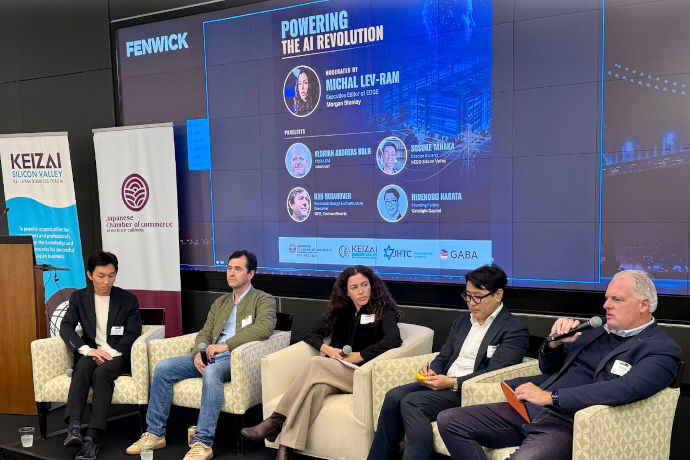
Powering the AI Revolution
AI is transforming our economy, but behind every breakthrough lies a fundamental challenge: getting enough electricity to the right place at the right time.
That was a central theme of yesterday’s Powering the AI Revolution discussion, co-organized by GABA Northern California – German American Business Association, the Japanese Chamber of Commerce of Northern California (JCCNC), Keizai Silicon Valley, and the JHTC Jewish High Tech Community with introductory remarks from Deputy Head of Mission at the German Consulate General in SF, Franciska Obermeyer, Consul General of Israel to the Pacific Northwest, Ron Gerstenfeld, and Consul General of Japan, Kotaro Otsuki.
Many thanks to our expert panelists Ran Bujanover, Florian Andreas Kolb, Hidenobu Nagata, Sosuke Tanaka, our excellent moderator Michal Lev-Ram, our partner organizations, our host Fenwick in Mountain View and everyone who joined us for this engaging discussion!
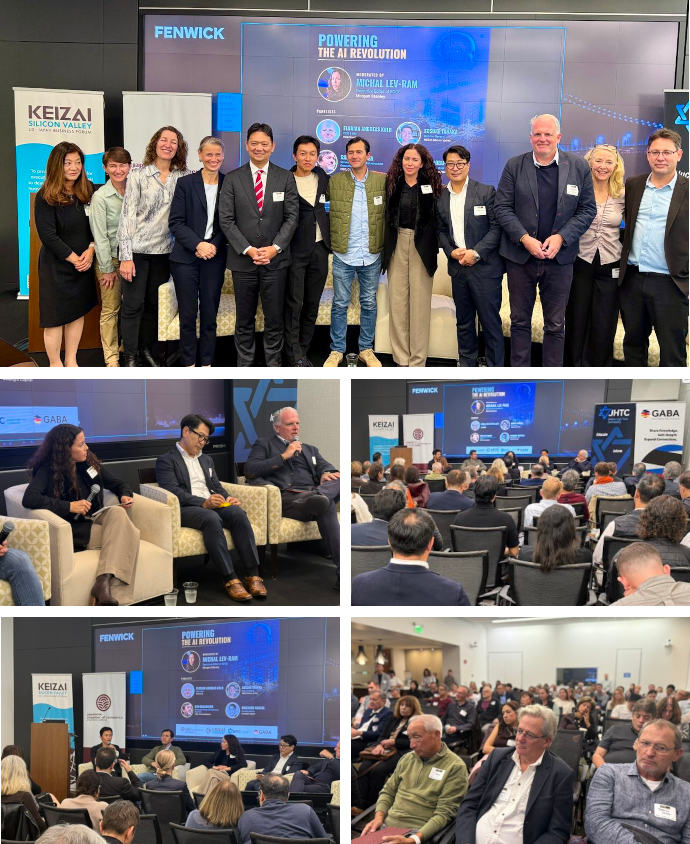
A few key takeaways:
- The challenge isn’t just generating electricity. It’s delivering it.
Solar power can be remarkably inexpensive, but grid connections have become a major bottleneck. Panelists discussed estimates that 20% of data centers face grid connection challenges, with long waiting times for installment.
- Can efficiency keep pace with demand?
As computing becomes cheaper and more efficient, demand tends to grow. With countless AI applications still untapped, panelists questioned whether efficiency gains could ever outpace the rapidly increasing need for computing power.
- Technology companies are becoming energy players—whether they want to or not.
Big Tech may not want to operate in the electricity market, but it can no longer ignore it. Significant investments are being made, yet financing new technologies and ensuring a return on investment remain major challenges.
- AI’s economic and societal impact goes far beyond infrastructure.
From banking and insurance to small businesses, AI is creating extraordinary opportunities. But it also raises questions about jobs, corporate decision-making, environmental impact, and how the economic benefits can be shared more equitably.
The recent U.S. midterm elections have brought renewed attention to data centers. Yet, as the panelists noted, the fundamentals haven’t changed: AI needs power, and demand for computation continues to grow.